
How Long Does Compost Take?
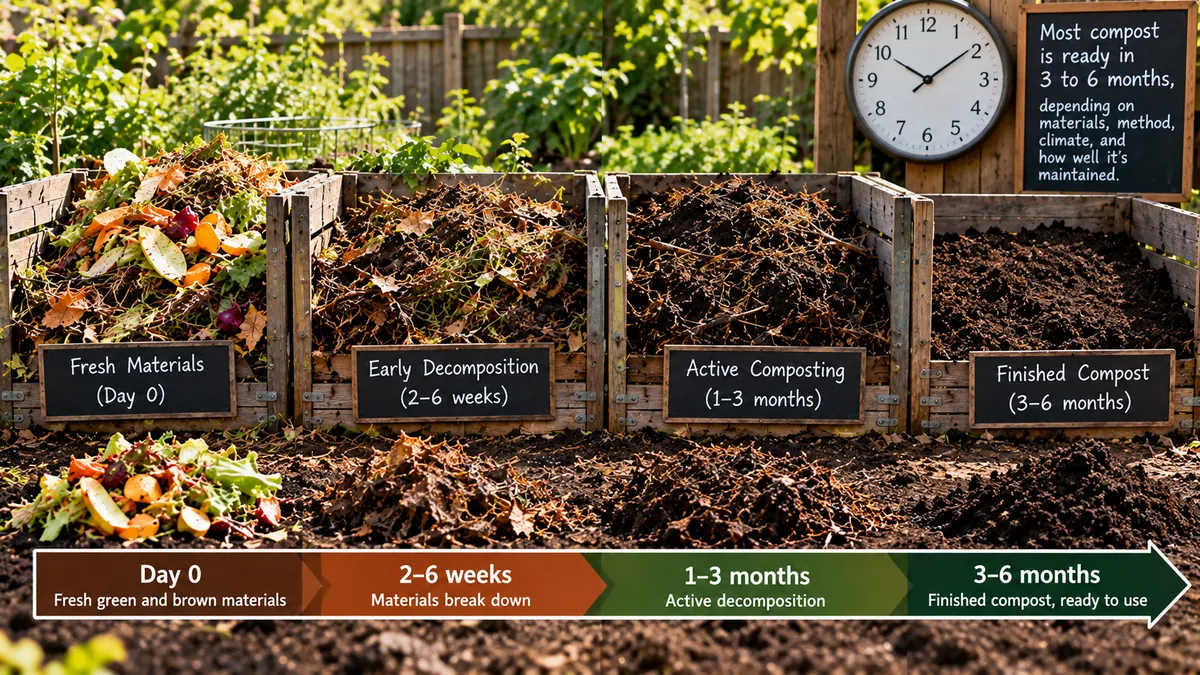
There is no single timeline for making compost. Some actively managed hot piles can transform suitable ingredients in a matter of weeks to a few months, while cold piles may take many months or longer. Worm composting follows its own pace, and the size of the bin, type of feedstock, climate, moisture, oxygen, and maintenance all influence the result. A calendar estimate is useful for planning, but maturity should be judged by the condition of the material rather than a guaranteed number of days.
Hot composting can be faster
Hot composting is designed to encourage rapid microbial activity. A sufficiently large pile with a workable carbon-to-nitrogen balance, adequate moisture, and oxygen can warm as microorganisms consume readily available material. Shredded ingredients generally process faster than large chunks. Turning can redistribute moisture and air and bring outer material into the active center. Under favorable conditions, the material may become substantially decomposed in a relatively short period.
However, a pile that heats up is not necessarily finished. Active decomposition may be followed by a curing stage in which the compost cools and stabilizes. The center may have been hot while the outer edges remained cool, and those outer materials may need more time. A claim that all compost will be ready in a fixed number of weeks ignores differences in ingredients, pile size, and management.
Cold composting takes patience
Cold composting usually involves adding suitable material over time and allowing natural decomposition to proceed with minimal turning. It is simple and requires less work, but the pile may remain cool, particularly in small systems or cold weather. Leaves, stems, and woody materials can persist for many months. Weed seeds and some pathogens may also survive because the pile does not receive a reliable high-temperature treatment.
Cold composting is a good option when convenience matters more than speed. The gardener can keep adding material and harvest only the older, mature portion if the system allows it. Otherwise, use a second pile or bin so fresh scraps do not continually reset the maturity of the whole batch. Patience is part of the method, not evidence that the system has failed.
Worm composting has different limits
Vermicomposting relies on composting worms and microorganisms in a managed bedding environment. It is useful for processing modest amounts of suitable kitchen scraps, but worms work best within a comfortable range of moisture and temperature. Overfeeding, poor ventilation, excess acidity, or extreme temperatures can slow the process and harm the worms. A worm bin may produce castings and partly decomposed bedding over time, but the contents still need to be assessed for maturity before use.
Because worm bins are often smaller than garden piles, they are not a direct replacement for a large yard-waste compost system. They are particularly useful when space is limited or the household produces relatively small quantities of scraps. Keep feeding rates matched to the bin's capacity instead of adding material faster than it can be processed.
What speeds decomposition?
Particle size is one of the easiest variables to control. Shredded leaves, torn cardboard, and chopped stems expose more surface area to microorganisms than large, intact pieces. A good mix of greens and browns provides nutrients and structure. Appropriate moisture keeps organisms active, while air spaces support aerobic decomposition. A pile large enough for its intended method retains heat better than a tiny, exposed heap, although very large piles can become compacted and difficult to aerate.
Regular observation also helps. Add water if the pile is dry, mix in browns if it is wet or smelly, and break apart compacted grass. Turning a hot pile can speed processing when oxygen is limiting, but excessive turning may cool or dry the material. A low-maintenance pile does not need the same schedule as a managed hot batch. Work with the method you chose rather than attempting to force every system into a fast timetable.
Why curing matters
After the most active phase, compost benefits from a curing period. During curing, slower decomposition continues and the material becomes more stable. Compost that is still actively breaking down may heat again when piled or mixed, and it can temporarily tie up nitrogen when incorporated into soil. Fresh, unfinished material may also have a stronger smell and a less uniform texture. Allowing the compost to cool and stabilize reduces these concerns.
Curing time depends on the feedstock and process. If the compost is intended for seedling mixes or containers, be particularly careful to use mature material and avoid unknown or contaminated ingredients. Some large fragments can be screened out and returned to the active pile, while the finer fraction is used where appropriate.
Judge the material, not just the calendar
Mature compost is usually dark, crumbly, and earthy-smelling. Most original ingredients are difficult to recognize, although woody pieces and eggshell fragments may remain. The pile has cooled after active decomposition and does not rapidly heat again under ordinary conditions. These clues are more useful than a promise that compost will be ready after a certain number of days.
If a pile is taking longer than expected, check its moisture, airflow, ingredient mix, particle size, and exposure to cold weather. If conditions are suitable and the material is simply slow, give it more time. Composting is a biological process, and the most dependable timeline is the one set by the maturity of the finished product.
Plan for more than one stage
It is useful to think of composting as active breakdown followed by curing and screening. A batch can look mostly decomposed yet still need time to stabilize, and screening may reveal woody pieces that need to return to the pile. If you need compost for a specific planting date, plan ahead and keep a reserve of mature material when possible. Do not rush unfinished compost into seedling trays simply because the calendar says it should be ready. A later application of stable compost is usually preferable to an early application of material that is still changing rapidly.
Next Article: How to Tell When Compost Is Finished
