
Managing Moisture, Airflow, and Temperature
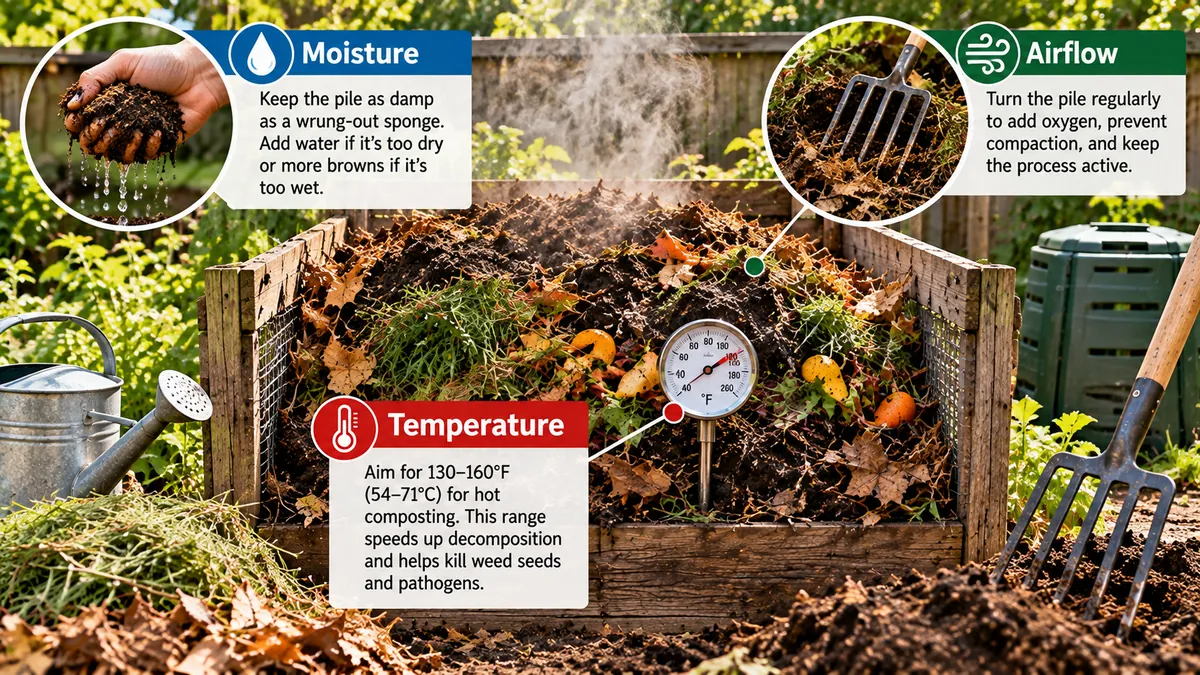
Composting depends on a few conditions that gardeners can observe and adjust: moisture, oxygen, and temperature. These factors work together. Microorganisms need water to carry out their activity, oxygen for efficient aerobic decomposition, and a suitable temperature range. When one condition becomes extreme, the pile may slow down, smell unpleasant, or become difficult to manage. The good news is that simple checks are usually enough for a home compost system.
Moisture: damp, not waterlogged
A compost pile should feel like a wrung-out sponge. It should be moist throughout, but squeezing a handful should release no more than a few drops. If the pile is too dry, microbes become less active and decomposition slows. Dry leaves may remain crisp and recognizable for months. If the pile is too wet, water fills pore spaces that would otherwise contain air, increasing the risk of anaerobic conditions and rotten odors.
Check moisture by taking a handful from inside the pile rather than judging only the surface. A covered pile can be dry in the center or wet underneath, depending on its ingredients and weather. If it is dry, sprinkle water while turning or mixing so moisture spreads evenly. Avoid flooding it all at once. If it is too wet, add dry leaves, shredded cardboard, straw, or other suitable absorbent browns. Break up compacted clumps and make sure excess rainwater can drain away.
Rain, wind, sun, and the type of bin all influence moisture. Open piles can become saturated in prolonged rain or dry quickly in hot, windy weather. A cover helps moderate those changes, but a completely sealed covering can trap excess moisture and restrict oxygen. Check the pile after major weather changes and adjust the cover as needed.
Airflow: oxygen keeps aerobic composting working
Most familiar backyard composting relies on aerobic organisms, which need oxygen. Air moves through the spaces between particles. Coarse ingredients such as small stems and loose leaves help preserve those spaces, while fine wet material can compact and block them. Turning the pile loosens compacted material and moves oxygen into the interior. A bin should have ventilation openings, and a pile should not be compressed tightly as it is built.
If the compost smells rotten, sour, or swampy, oxygen may be limited. Mix in dry, coarse browns, break up mats of grass, and turn or loosen the material. Avoid adding another large load of wet scraps until the pile has recovered. Some earthy or plant-like odor is normal, especially after adding fresh material; a strong persistent foul smell is a sign to inspect moisture and airflow.
Turning is not the only way to provide oxygen. A well-structured pile with suitable ingredients may remain aerated without frequent turning. Excessive handling can dry material out and may be unnecessary for a cold compost pile. Use turning as a response to the system's needs and as part of a deliberate hot-composting plan, not as a rule that must be followed every few days in all circumstances.
Temperature and microbial heat
As microorganisms consume readily available food, they release heat. A sufficiently large, moist, aerated pile can become warm or hot during active decomposition. Temperature is influenced by pile size, ingredient mix, weather, moisture, and how much oxygen reaches the center. A pile that heats and later cools may be moving from its most active phase into slower decomposition and curing.
Not every successful compost pile becomes visibly hot. Small bins, worm systems, and cold compost piles may stay close to ambient temperature while still processing organic material. A lack of heat does not automatically mean failure. Check whether the pile is too small, too dry, too wet, or dominated by slow-to-decompose browns before trying to make it hotter.
A compost thermometer is useful for gardeners deliberately managing a hot pile, especially when they want to track the temperature at several points and turn the material according to a plan. Temperature management can help reduce some weed seeds and pathogens, but only when the necessary conditions and exposure are achieved throughout the material. A single high reading in the center does not prove that every part has received adequate heat. Ordinary home piles should not be assumed to be sanitized.
How weather and pile size affect conditions
Rain can saturate a pile and wash fine material into compacted pockets. Drought and wind can dry exposed surfaces. Cold weather slows microbial activity, while very hot weather increases moisture loss. Large piles can retain heat but may become compacted or difficult to aerate; very small piles lose heat quickly and may be more affected by surrounding temperatures. There is no one ideal size for every method, but the pile should be large enough to manage and accessible enough to maintain.
Particle size also matters. Large stems and branches decompose slowly, while very fine particles can settle into dense layers. A mixture of particle sizes usually gives a better balance of surface area and air spaces. Mix grass clippings with dry leaves rather than leaving them in a thick mat, and avoid packing scraps tightly into a small container.
A simple troubleshooting routine
When the pile is slow, check moisture first, then airflow and ingredients. If it is dry, add water. If it is wet and smelly, add browns and loosen it. If it is damp and airy but cool, consider whether the pile is small, whether the weather is cold, and whether the ingredients are mostly resistant material. Add a modest amount of greens if appropriate and wait for a response. Change conditions gradually so you can see what helps.
A healthy compost pile is not a machine that must remain at one temperature or moisture level every day. It is a living process that changes over time. The gardener's job is to keep the conditions broadly suitable, recognize warning signs, and avoid overcorrecting. Damp material, good air spaces, and patience provide a reliable foundation for compost that is useful in the garden.
A quick inspection after heavy rain or several hot, windy days is often more useful than checking on an arbitrary daily schedule. These weather changes can alter moisture dramatically, especially in small bins. Adjust only what the pile needs, and remember that cool compost can still mature successfully.
Next Article: Turning and Maintaining Compost
