
Getting the Carbon-to-Nitrogen Balance Right
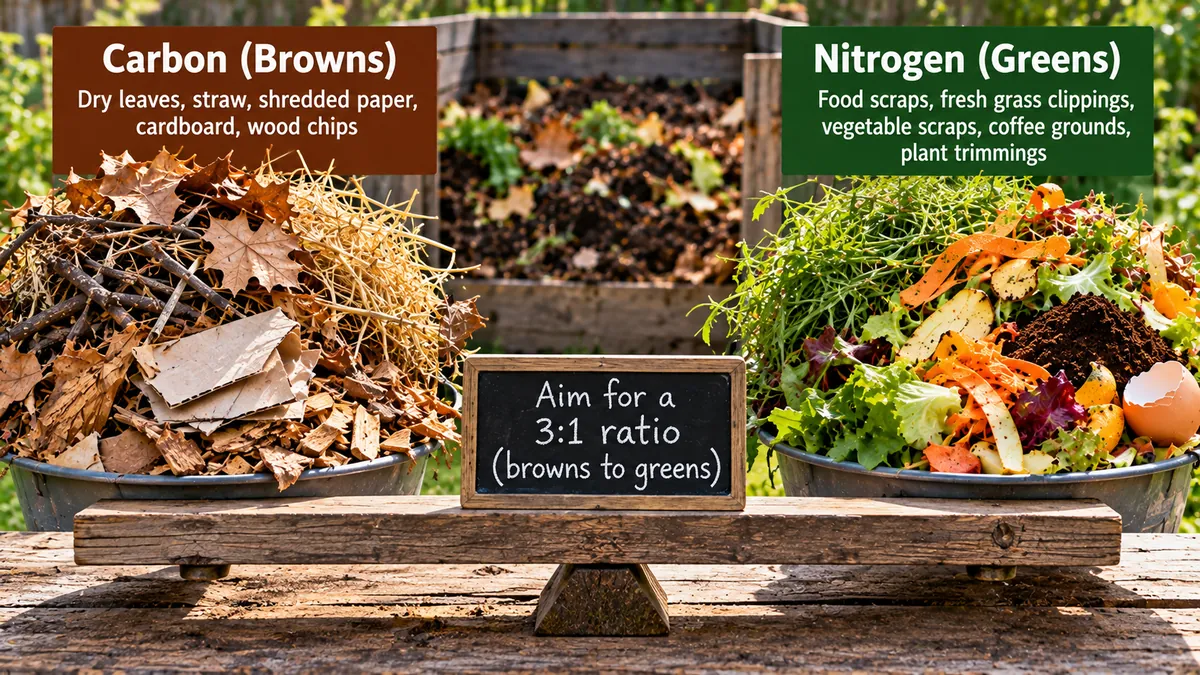
Microorganisms need both carbon and nitrogen to decompose organic material efficiently. Carbon supplies energy and forms part of microbial cells, while nitrogen is needed for proteins and other compounds involved in growth. Composters often discuss this relationship as the carbon-to-nitrogen ratio, or C:N ratio. Understanding the basic idea helps gardeners diagnose a pile that smells of ammonia or sits unchanged for months, but it does not require complicated calculations for everyday home composting.
The commonly cited ratio
A frequently cited starting target for active composting is a carbon-to-nitrogen ratio of approximately 25:1 to 30:1 by mass. This means that the mixture contains roughly 25 to 30 parts carbon for each part nitrogen. The ratio is not a recipe measured by buckets, because different ingredients have different densities and moisture contents. A bucket of dry leaves weighs much less than a bucket of wet grass clippings, and their carbon and nitrogen contents differ as well.
For a home gardener, the target is best treated as a guide rather than a number that must be achieved exactly. Ingredient composition varies, and decomposition also depends on water, oxygen, temperature, particle size, and pile volume. A mixture with a reasonable C:N ratio can still fail if it is waterlogged or too dry. Conversely, a pile that is not perfectly balanced on paper may break down satisfactorily when its physical conditions are good.
Practical proportions of browns and greens
Begin with a larger volume of dry browns than wet greens, then adjust based on the materials. A common starting point is to mix several portions of loose, dry leaves or shredded cardboard with one portion of fresh kitchen scraps or grass clippings. This is only a rough volume-based guide, not a universal formula. Very dry leaves may need more nitrogen-rich material and water; very wet scraps may need a much larger amount of browns.
Mixing is generally more reliable than building rigid layers. Thick layers of grass can mat together, while a deep layer of leaves may remain dry in the center. Distribute the ingredients so that moisture and air can move through the pile. If you add scraps frequently, cover each addition with dry leaves or shredded cardboard. Keeping browns nearby makes the process simple and helps prevent small problems from becoming persistent odors.
Signs of excess nitrogen
A pile with too much readily available nitrogen may produce a strong ammonia smell. It may also be wet, sticky, or compacted if the nitrogen-rich materials are fresh and moist. The correction is usually to add dry, carbon-rich material such as leaves, straw, or shredded untreated cardboard, then mix or turn the pile to introduce oxygen. Add browns gradually, checking the texture and smell as you go. A single huge addition of very dry material can create separate dry pockets, so mix it through the wet material.
A rotten or sour smell is not always evidence of excess nitrogen alone. It often signals that oxygen is limited because the pile is too wet or compacted. In that case, dry browns help, but so do loosening the mixture, improving drainage, and avoiding dense mats of grass or scraps. Odor is a useful clue, not a complete diagnosis.
Signs of excess carbon
A pile containing too much carbon-rich material may decompose very slowly. Dry leaves, straw, cardboard, and woody material can remain recognizable for a long time if the mixture lacks nitrogen, moisture, or enough active microbial material. If the pile is also dry, moisten it as you add fresh greens. Mix the ingredients so the nitrogen-rich material is distributed rather than concentrated in a small pocket.
Slow decomposition does not always mean that the C:N ratio is wrong. Large branches, whole leaves, cold weather, insufficient pile volume, or low moisture can all delay the process. Shred bulky material, check moisture, and assess whether the pile is large enough for the method you are using. A cold compost pile may simply need more time, even when the mix is reasonable.
Make corrections gradually
When a pile seems out of balance, change one or two conditions at a time. If it smells strongly of ammonia, mix in dry browns and check airflow. If it is dry and inactive, add water and a modest amount of green material. If it is soggy and sour, add absorbent browns and loosen compacted areas. Avoid adding large quantities of fertilizer in an attempt to accelerate composting; concentrated nutrients can create imbalances and are rarely necessary for a normal household pile.
Keep in mind that the C:N ratio changes as decomposition proceeds. Microorganisms consume different compounds at different rates, and carbon is lost partly as carbon dioxide. The mixture you begin with will not have the same composition as the mature compost you harvest. This is one reason exact calculations for every addition are unnecessary in a small home system.
A simple example
Imagine a gardener adds a bucket of vegetable scraps and a large bag of fresh grass clippings to a bin. The contents become wet and develop an unpleasant smell. The gardener can mix in several handfuls or buckets of dry shredded leaves, breaking apart the grass mat as they work. If the pile is still saturated, more coarse browns and improved drainage may be needed. After a few days, the gardener checks the smell and moisture again rather than continuing to add greens.
In another case, a pile of mostly dry autumn leaves remains unchanged. The gardener can shred the leaves, moisten them, and mix in a moderate amount of vegetable scraps or grass clippings. The goal is a damp, airy blend, not a precise measurement.
The most useful rule is to balance ingredients by observation. Use the C:N ratio to understand why a mixture needs both greens and browns, then let smell, moisture, texture, and progress guide small adjustments. Good composting depends on the whole environment, not one number alone.
A beginner should think of balance as a range, not a fixed ratio that must be achieved with every addition. Materials vary, and the pile's condition is the most useful guide. Make corrections in modest amounts, then give the mixture time to respond before adding more.
Next Article: How to Start a Compost Pile Step by Step
